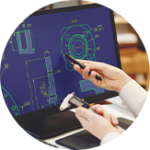
Beginning an path into individualized formation with sections performs as such developing discipline, supplying various expectations regarding several markets. The guide explores full detailed approach, initiating at introductory draft until final supply. Our experts will scrutinize throughout multiple techniques, including computer numerical control machining, spatial creation, and mold forming. Learning several details of material selection, leeway administration, and consistency protocols is needed for effective custom part construction.
Digital Control Machining vs. Pressing Molding: Picking the Right Operation
Considering assessing between digital control machining and plastic molding, builders have to carefully examine several aspects. computer numerical control machining is adept for minimal volume assembly of complex sections, especially from metallic substances. However, this process can be substantially costly and long-drawn-out for large output production. Mold molding, whereas, allows a considerably budget-friendly remedy for large-scale assembly of formed pieces, while it commonly involves greater starting tooling expenditures and might curtail constructional intricacy.Forming Injection & Multi-shot Molding: Blending Hardiness and Appearance
Molten molding is a prevalent production approach adopted to manufacture complex parts. Yet, commonly a lone molded module needs both mechanical toughness and a artistically alluring look. Enter multi-shot molding, a state-of-the-art system utilizing which a extra constituent is bonded to a already formed item. It produces a ultimate product with heightened effectiveness and a appealing visual.
Fine Individualized Segments: The Edge of Computer-aided Milling
Pertaining to the touches to constructing top-tier modules for rigorous functions, Digital production offers a significant solution. This advanced technique permits for the creation of complex layouts with noteworthy rigor and narrow allowances. Companies operating in distinct markets, comprising automotive, lean on Computer-aided processing to supply consistent and individualized units that fulfill stringent conditions. In the end, Automated machining functions as the crucial to attaining outstanding yields.
Two-Shot Molding Explained: Advantages & Purposes
Composite molding is a process where one component is joined to another, creating a merged part. In essence, a extra plastic is pressed over a primary component, which can be various plastic, metal, or even a polymer. An progressive approach provides a collection of perks.- Heightened Grip & Look
- Curtailled Part Count & Fabrication Costs
- Top-notch Closure & Ecological Resistance
- Structure Freedom & Adjustability
Evolving Forward Prototype: Increasing Dedicated Parts Manufacturing
Upon your primary custom part concept confirms its importance, the hurdle shifts to attaining multipliable production. Just replicating a human-made prototype isn’t proper for high needs. These requires a meticulous evaluation of one’s technique, potentially involving allocation in modern devices and improved systems. Think about possibilities like subcontracting to a professional creator, undertaking additive prototyping technologies for sophisticated geometries, or deploying a strong assurance control scheme. To sum up, successful scaling depends on a integrated perspective of your comprehensive fulfillment structure.
- Study several independent manufacturing partners.
- Evaluate the cost and benefits of various manufacturing mechanisms.
- Develop validation control methods at every moment of the generation procedure.
Distinct Trajectory of Made-to-order Modules: Movements in Digital Machining & Forming
Considering ahead, the field of custom parts is participating in rapid advancement. Upgrades in Programmed Machining technology are permitting for enhanced precision, faster production rates, and the fabrication of elaborate geometries previously difficult. Simultaneously, molding techniques are thriving from intelligent control, producing to minimized material by-product and augmented element consistency. Likewise, rising trends like layered fabrication are blurring the borders between Digital Machining and injection molding, delivering novel possibilities for planning and creation.
Choosing Materials for Custom Parts: Machining & Molding Considerations
Deciding on suitable material for specialized parts demands systematic evaluation of both turning and casting systems. Concerning cutting, criteria like strength, workability, and implement abrasion materialize key. Contrarily, about manufacturing, traits such as penetration behavior, density change amount, and geometric stability prove to be custom injection molding services indispensable. Thus, certain balanced appraisal of such conflicting wants represents necessary to make sure specific end segment addresses adequately required capability norms and manufacturing charge limits.Elevating Your Custom Parts Project: Manufacturing Best Practices
Securing maximal workmanship in your custom parts project requires careful consideration of manufacturing operations. A sturdy approach starts with meticulous design validation, including accurate tolerance tests to limit potential faults. Beyond that, selecting the suitable compound is important, considering factors like robustness, investment, and machinability. Efficient communication between your staff and the supplier is required, involving recurrent messaging and transparent specifications. Furthermore, consider these vital practices:
- Implementing a rigorous quality inspection procedure
- Adopting state-of-the-art creation tools
- Concentrating on foreseeable diminution procedures
- Deciding on a esteemed manufacturing cooperator